Sách keo gáy, bìa mềm
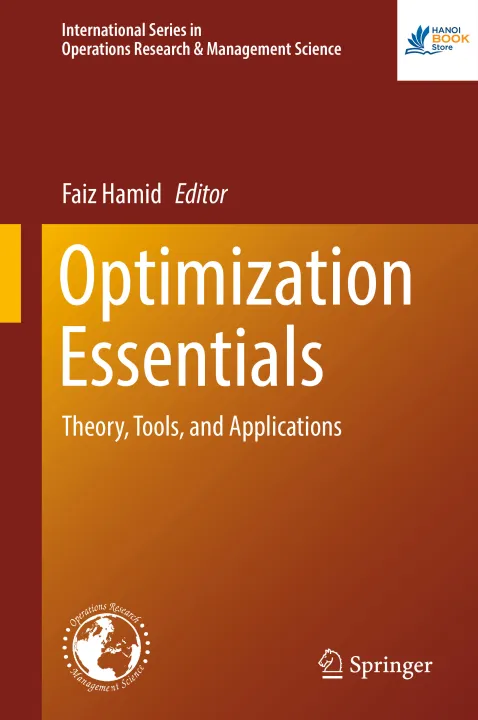
The birth of modern operations research (OR) can be traced back to radar detection
activities in the UK during World War II, although several important concepts such
as queueing theory and the economic order quantity were already known. After
the war, OR witnessed a significant growth and was applied to a wide variety of
sectors, with manufacturing, natural resources, agriculture, telecommunications, and
transportation attracting the most attention.
Many practical problems in these areas can be modeled as large systems which
must be optimized, and mathematical programming is the most common optimization
tool. The advent of the simplex algorithm for linear programs in the late 1940s lies
at the heart of mathematical programming and has spawned several subfields such as
integer programming, nonlinear programming, and stochastic programming which
sustain most application areas. Classical mathematical programming methodologies
borrow extensively from concepts belonging to fundamental mathematics, such as
calculus, linear algebra, and probability and statistics, and have greatly benefitted
from advances in discrete optimization. Branch-and-bound, branch-and-cut, column
generation, and several other decomposition techniques are now routinely employed
for the solution of most problems.
Categories:Technique - Others
Content Type:Books
Volume:null
Year:2025
Edition:1
Language:english
Pages:803