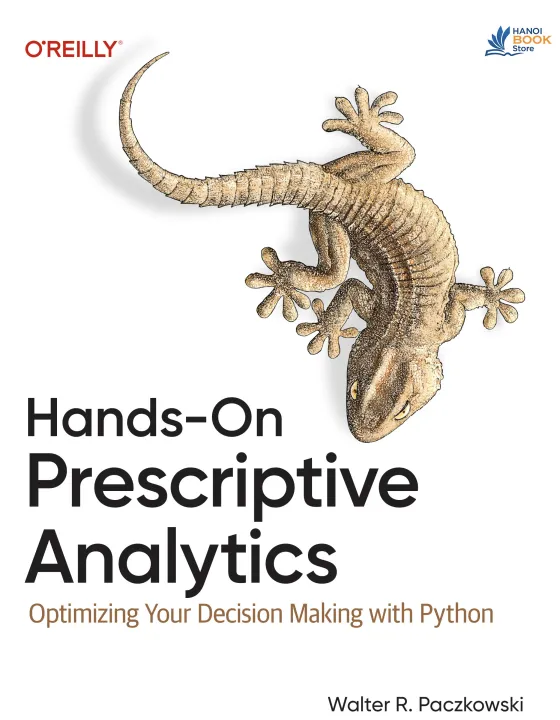
Sách keo gáy, bìa mềm
Business decisions in any context—operational,
tactical, or strategic—can have considerable consequences. Whether the
outcome is positive and rewarding or negative and damaging to the
business, its employees, and stakeholders is unknown when action is
approved. These decisions are usually made under the proverbial cloud of
uncertainty.
With this practical guide, data analysts, data
scientists, and business analysts will learn why and how maximizing
positive consequences and minimizing negative ones requires three forms
of rich information: Descriptive analytics explores the results from an
action—what has already happened. Predictive analytics focuses on what
could happen. The third, prescriptive analytics, informs us what should
happen in the future.
While all three are important for
decision-makers, the primary focus of this book is on the third:
prescriptive analytics. Author Walter R. Paczkowski, Ph.D. shows you
• The distinction among descriptive, predictive, and prescriptive analytics
• How predictive analytics produces a menu of action options
• How prescriptive analytics narrows the menu of action options
• The forms of prescriptive analytics: eight prescriptive methods
• Two broad classes of these methods: non-stochastic and stochastic
• How to develop prescriptive analyses for action recommendations
• Ways to use an appropriate tool-set in Python
Categories:Computers - Programming
Year:2024
Edition:1
Language:english
Pages:412