Deep Learning for Computer Vision with Python, Volume 3 (sách keo gáy bìa mềm)
Thể loại:Computers - Algorithms and Data Structures
Tập:3-ImageNetBundle
Năm:2017
In lần thứ:1.2.1
Nhà xuát bản:PyImageSearch
Ngôn ngữ:english
Trang:323
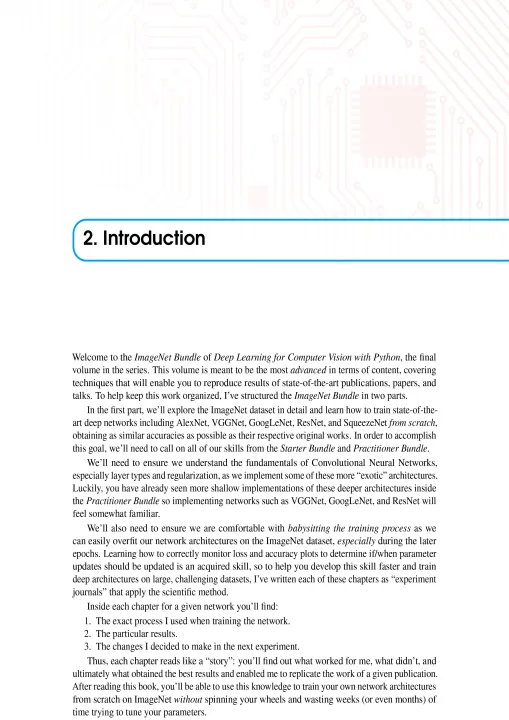
Welcome to the ImageNet Bundle of Deep Learning for Computer Vision with
Python, the final volume in the series. This volume is meant to be the
most advanced in terms of content, covering techniques that will enable
you to reproduce results of state-of-the-art publications, papers, and
talks. To help keep this work organized, I've structured the ImageNet
Bundle in two parts.
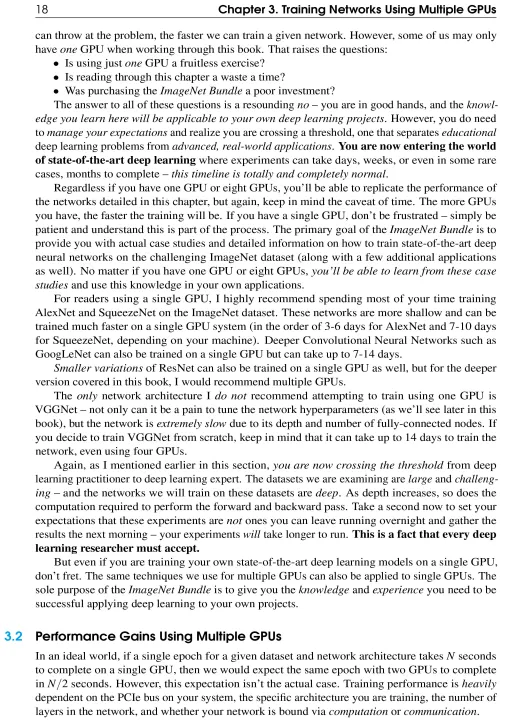
In the first part, we'll explore the ImageNet
dataset in detail and learn how to train state-of-the art deep networks
including AlexNet, VGGNet, GoogLeNet, ResNet, and SqueezeNet from
scratch, obtaining as similar accuracies as possible as their respective
original works. In order to accomplish this goal, we’ll need to call on
all of our skills from the Starter Bundle and Practitioner Bundle.
The
second part of this book focuses on case studies – real-world
applications of applying deep learning and computer vision to solve a
particular problem. We'll first start off by training a CNN from scratch
to recognition emotions/facial expressions of people in real-time video
streams. From there we’ll use transfer learning via feature extraction
to automatically detect and correct image orientation. A second case
study on transfer learning (this time via fine-tuning) will enable us to
recognize over 164 vehicle makes and models in images. A model such as
this one could enable you to create an “intelligent” highway billboard
system that displays targeted information or advertising to the driver
based on what type of vehicle they are driving. Our final case study
will demonstrate how to train a CNN to correctly predict the age and
gender of a person in a photo.