Sách keo Gáy
Thể loại:Medicine
Năm:2009
In lần thứ:2
Nhà xuát bản:Springer-Verlag New York
Ngôn ngữ:english
Trang:300 / 304
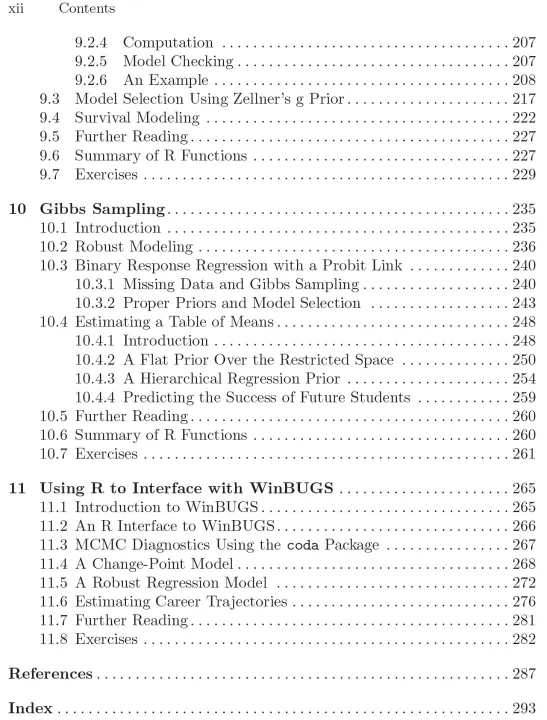
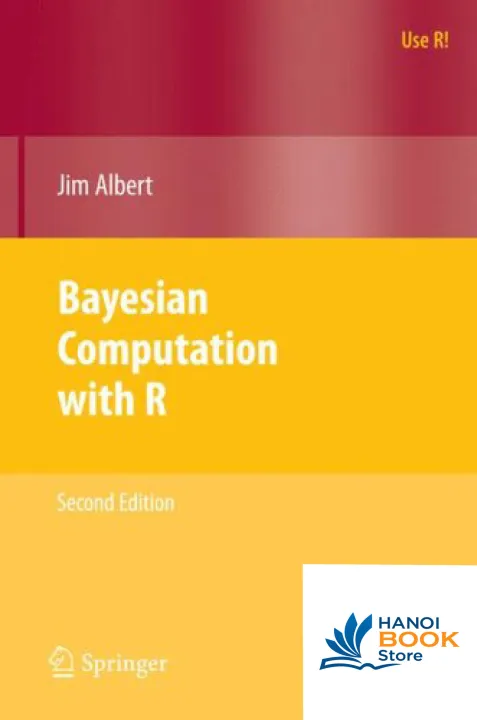
There has been a dramatic growth in the
development and application of Bayesian inferential methods. Some of
this growth is due to the availability of powerful simulation-based
algorithms to summarize posterior distributions. There has been also a
growing interest in the use of the system R for statistical analyses.
R's open source nature, free availability, and large number of
contributor packages have made R the software of choice for many
statisticians in education and industry.
Bayesian Computation with
R introduces Bayesian modeling by the use of computation using the R
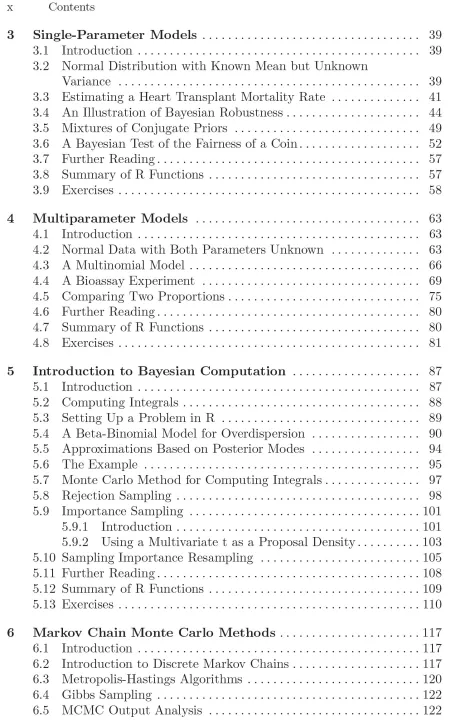
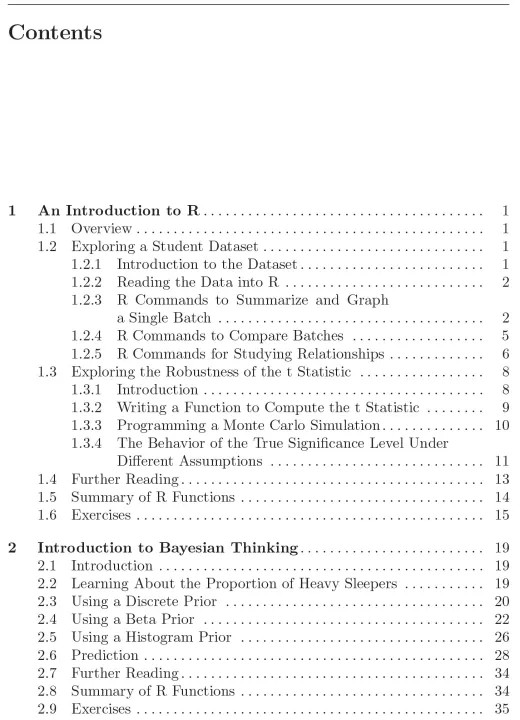
language. The early chapters present the basic tenets of Bayesian
thinking by use of familiar one and two-parameter inferential problems.
Bayesian computational methods such as Laplace's method, rejection
sampling, and the SIR algorithm are illustrated in the context of a
random effects model. The construction and implementation of Markov
Chain Monte Carlo (MCMC) methods is introduced. These simulation-based
algorithms are implemented for a variety of Bayesian applications such
as normal and binary response regression, hierarchical modeling,
order-restricted inference, and robust modeling. Algorithms written in R
are used to develop Bayesian tests and assess Bayesian models by use of
the posterior predictive distribution. The use of R to interface with
WinBUGS, a popular MCMC computing language, is described with several
illustrative examples.
This book is a suitable companion book for
an introductory course on Bayesian methods and is valuable to the
statistical practitioner who wishes to learn more about the R language
and Bayesian methodology. The LearnBayes package, written by the author
and available from the CRAN website, contains all of the R functions
described in the book.
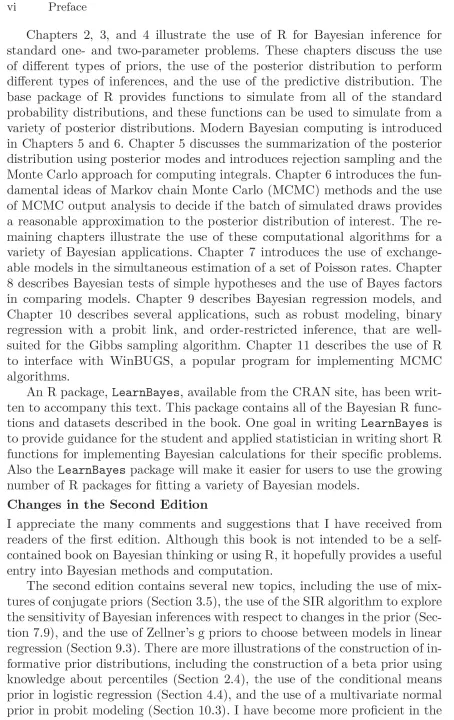
The second edition contains several new topics such as the use of mixtures of conjugate priors and the use of Zellner’s g
priors to choose between models in linear regression. There are more
illustrations of the construction of informative prior distributions,
such as the use of conditional means priors and multivariate normal
priors in binary regressions. The new edition contains changes in the R
code illustrations according to the latest edition of the LearnBayes
package.
Jim Albert is Professor of Statistics at Bowling Green
State University. He is Fellow of the American Statistical Association
and is past editor of The American Statistician. His books include Ordinal Data Modeling (with Val Johnson), Workshop Statistics: Discovery with Data, A Bayesian Approach (with Allan Rossman), and Bayesian Computation using Minitab.