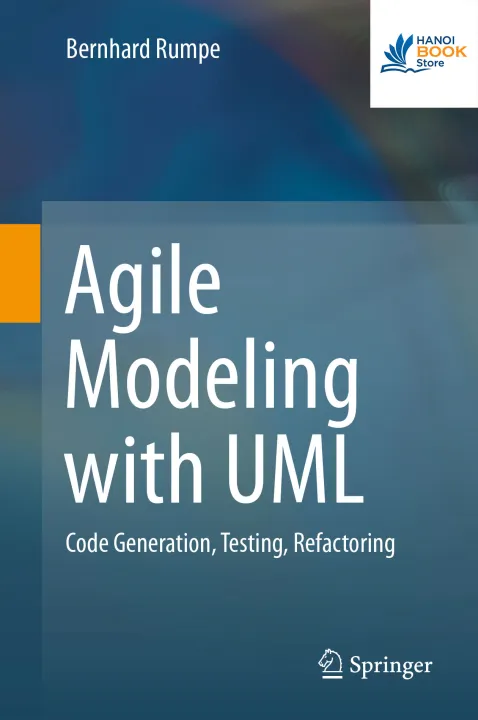
Sách keo gáy, Bìa mềm
Thể loại:Computers - Programming
Năm:2017
In lần thứ:1
Ngôn ngữ:english
Trang:388 / 394
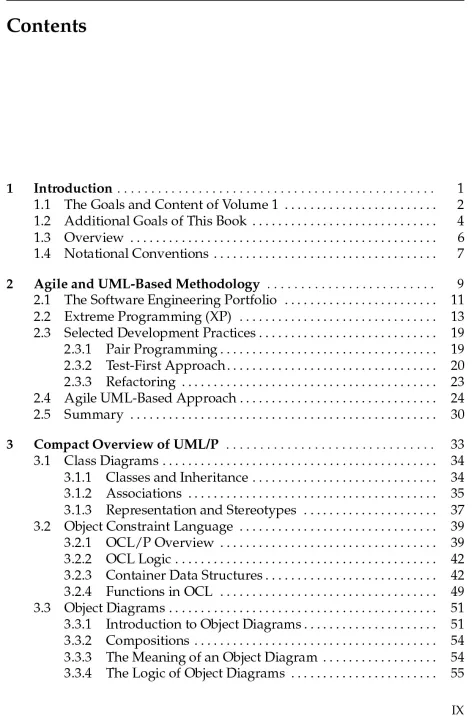
This book focuses on the methodological treatment of UML/P and addresses
three core topics of model-based software development: code generation,
the systematic testing of programs using a model-based definition of
test cases, and the evolutionary refactoring and transformation of
models. For each of these topics, it first details the foundational
concepts and techniques, and then presents their application with UML/P.
This separation between basic principles and applications makes the
content more accessible and allows the reader to transfer this knowledge
directly to other model-based approaches and languages.
After an
introduction to the book and its primary goals in Chapter 1, Chapter 2
outlines an agile UML-based approach using UML/P as the primary
development language for creating executable models, generating code
from the models, designing test cases, and planning iterative evolution
through refactoring. In the interest of completeness, Chapter 3 provides
a brief summary of UML/P, which is used throughout the book. Next,
Chapters 4 and 5 discuss core techniques for code generation, addressing
the architecture of a code generator and methods for controlling it, as
well as the suitability of UML/P notations for test or product code.
Chapters 6 and 7 then discuss general concepts for testing software as
well as the special features which arise due to the use of UML/P.
Chapter 8 details test patterns to show how to use UML/P diagrams to
define test cases and emphasizes in particular the use of functional
tests for distributed and concurrent software systems. In closing,
Chapters 9 and 10 examine techniques for transforming models and code
and thus provide a solid foundation for refactoring as a type of
transformation that preserves semantics.
Overall, this book will be
of great benefit for practical software development, for academic
training in the field of Software Engineering, and for research in the
area of model-based software development. Practitioners will learn how
to use modern model-based techniques to improve the production of code
and thus significantly increase quality. Students will find both
important scientific basics as well as direct applications of the
techniques presented. And last but not least, the book will offer
scientists a comprehensive overview of the current state of development
in the three core topics it covers.